
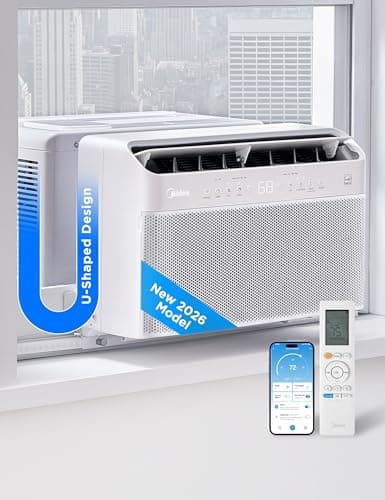
Midea U-Shaped vs traditional window AC (2026): Which Should You Actually Buy?
At a Glance
| Category | Midea U-Shaped | GE Traditional Window AC |
|---|---|---|
| Cooling Capacity | 12,000 BTU; up to 550 sq ft | 5,000 BTU; up to 150 sq ft |
| Noise | As low as 32 dBA | 52–56 dBA |
| Energy Efficiency | 37% energy savings; ENERGY STAR | 440W power draw; washable filter |
| Smart Features | Wi-Fi, app control, Alexa/Google Assistant | Manual dials, no app or Wi-Fi |
| Window Use | Allows window opening and better view | Window stays mostly occupied by unit |
| Price | 6% OFF — Was $509.99 ✓ Prime $479.99 | ✓ Prime $159.00 |
Design
Winner: Midea U-Shaped
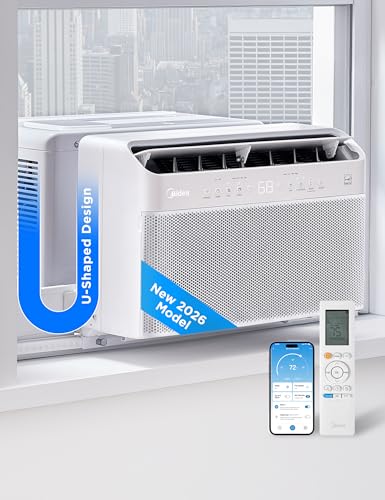

The biggest design advantage in the Midea U-Shaped vs traditional window AC debate is simple: the U-shaped unit uses your window as part of the structure, which helps block outside noise while still letting you open the window. That makes it feel less like a bulky appliance and more like a cleaner, more livable installation.
The GE unit is a classic fixed-chassis window AC, which is straightforward and compact for small spaces, but it occupies the window more completely. If you want the least intrusive experience and a better view, the Midea is the more premium design choice.
Why Midea wins: better window functionality, quieter structure, and a more modern feel.
Performance
Winner: Midea U-Shaped

On pure cooling performance, the Midea is in a different class. Its 12,000 BTU capacity is designed for rooms up to 550 sq ft, while the GE is built for small rooms up to 150 sq ft. If you need to cool a bedroom, dorm, office, or studio, the GE can be enough; if you need to handle a larger living area, the Midea is the clear winner.
Noise matters too. Midea’s inverter design claims operation as low as 32 dBA, which is dramatically quieter than the GE’s 52–56 dBA range. That difference is huge for sleep, work-from-home setups, and TV watching.
Why Midea wins: more cooling capacity, much lower noise, and inverter-driven efficiency.
Value
Winner: GE Window Air Conditioner
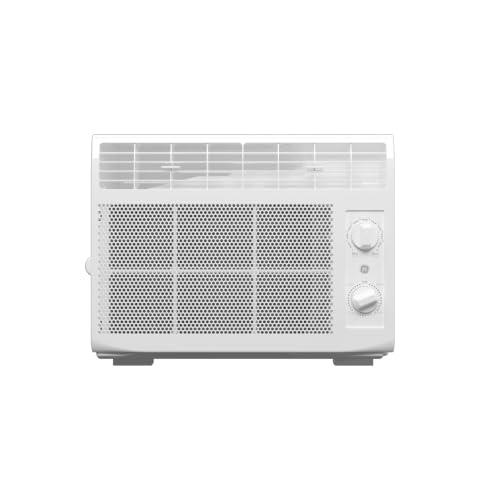

If your budget is tight, the GE is the better value by a wide margin. At $159, it costs far less than the Midea’s $479.99 price tag. For shoppers who only need to cool a small room, paying more for the Midea may not be necessary.
That said, value depends on use case. The Midea costs more because it delivers more: bigger coverage, quieter performance, smart controls, and energy savings. But for a small bedroom or office, the GE gives you the core function of cooling at a much lower entry price.
Why GE wins: lower upfront cost and strong practicality for small spaces.
Battery/Durability
Winner: GE Window Air Conditioner

Neither product has a battery, so durability and long-term reliability are the real comparison points here. The GE’s appeal is its simplicity: manual controls, fewer electronic layers, and a washable reusable filter. Fewer features can sometimes mean fewer things to go wrong over time.
The Midea is more advanced, with Wi-Fi, app control, and inverter technology. Those features are excellent for comfort and efficiency, but they also make the unit more complex. If you want a straightforward machine with less setup and fewer digital dependencies, the GE has the edge in durability-minded buying.
Why GE wins: simpler design, fewer smart components, and easier long-term maintenance.
Installation and Ease of Use
Winner: GE Window Air Conditioner


Both units are designed for DIY installation, but the GE is easier to understand for most buyers. Its mechanical controls are intuitive, and the included EZ Mount kit with foam insulation is made for a straightforward setup. It is especially appealing if you do not want to deal with apps, pairing, or smart-home configuration.
The Midea’s quick-snap bracket and sidearms are also practical, but the U-shaped design is more specialized and may feel less familiar to buyers used to traditional window ACs. If you want the simplest install-and-go experience, GE is the easier win.
Why GE wins: simpler controls and a more familiar install process.
Midea U-Shaped Is the Better Choice If…
- You want the quietest possible operation for sleeping or working.
- You need to cool a larger room up to 550 sq ft.
- You care about energy savings and lower long-term operating cost.
- You want Wi-Fi, app control, and Alexa/Google Assistant compatibility.
- You like the idea of opening the window while the AC is installed.
- You’re willing to pay more for a premium, modern window AC.
GE Window Air Conditioner Is the Better Choice If…
- You only need to cool a small room up to 150 sq ft.
- You want the lowest upfront price.
- You prefer simple manual controls over smart features.
- You want a basic, dependable window AC with easy installation.
- You’re buying for a bedroom, dorm, office, or studio apartment.
- You value simplicity and lower complexity over premium features.
Our Final Verdict
The overall winner in the Midea U-Shaped vs traditional window AC comparison is the Midea 12,000 BTU U Shaped Smart Inverter Window Air Conditioner. It delivers far better cooling coverage, much quieter operation, smarter controls, and real energy-saving benefits that justify its higher price for many buyers.
That said, the GE Window Air Conditioner 5,000 BTU AC Unit is the smarter budget pick if you only need to cool a small room and want a no-frills machine that gets the job done.
Best overall: Midea for performance, comfort, and efficiency. Best budget pick: GE for small-room cooling.
Frequently Asked Questions
Is a Midea U-shaped AC better than a traditional window AC?
Yes, for most buyers who want quieter operation, better energy efficiency, and smarter controls. Traditional window ACs are still better if you want a lower price and simple cooling for a small room.
Why is the Midea U-shaped air conditioner so quiet?
Its U-shape uses the window to help block outside noise, and its inverter system reduces vibration. Midea claims operation as low as 32 dBA, which is much quieter than many standard window units.
Is the GE window AC good for a bedroom?
Yes, especially if the bedroom is small. The GE is designed for rooms up to 150 sq ft and offers quieter operation than many older basic units, though it is still louder than the Midea.
Does the Midea U-shaped AC save money on electricity?
It can. Midea says its DC inverter technology delivers more than 37% energy savings compared with traditional units, which may reduce operating costs over time.
Which is easier to install, Midea U-shaped or traditional window AC?
Most people will find the traditional GE unit easier to understand and install because it uses a familiar fixed-chassis design and simple mechanical controls. The Midea is still DIY-friendly, but it is more specialized.
Get the Full Heating, Cooling & Air Quality Buyer's Guide
Download our detailed comparison with specs, scores, and our honest verdict — delivered straight to your inbox.
Free. No spam. Unsubscribe anytime.
Was this review helpful?
Be the first to share your feedback on this review.
Sign in to vote and let us know what you think.
Discussion (0)
No comments yet. Be the first to start the discussion.
Related Reviews
7 Best Air Purifiers for Smoke in 2026 — Cleaner Air for Wildfire Season, Odors, and Dust
If wildfire smoke is creeping into your home, you need an air purifier that can actually help—not just look good on a product page. The best air purifiers for smoke combine strong CADR, HEPA-grade filtration, and activated carbon to reduce fine particles and lingering odors. We picked these models f
Best Alternatives to Dyson in 2026 — Cheaper, Better, or Both?
If you’re searching for Dyson alternatives cheaper , you’re probably tired of paying premium prices for features you may not even use. Dyson’s brand power is strong, but so is the sticker shock, and many buyers want similar air-cleaning performance without the luxury markup. This guide breaks down t
Frigidaire vs hOmeLabs dehumidifier (2026): Which Should You Actually Buy?
If you’re stuck deciding between Frigidaire 5,000 BTU Window-Mounted Air Conditioner and hOmeLabs Dehumidifier 3,500 Sq Ft Wi-Fi , the real problem is simple: you want the right machine for your room without overspending on features you won’t use. One is built to cool a small space fast, while the o