
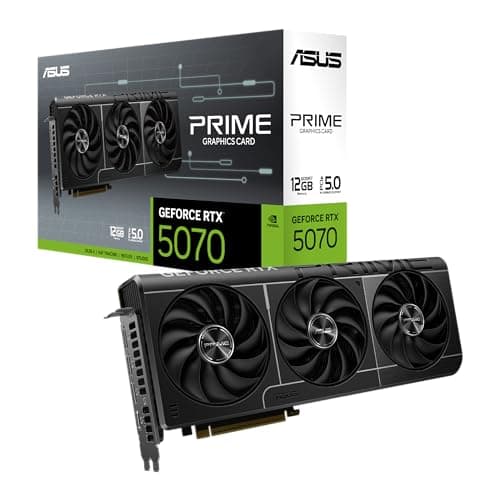
RTX 5070 vs RX 9070 XT (2026): Which Should You Actually Buy?
At a Glance
| Category | RTX 5070 | RX 9070 XT |
|---|---|---|
| GPU / Architecture | NVIDIA Blackwell | Radeon RX 9070 XT |
| Memory | 12GB GDDR7 | 16GB GDDR6 |
| Cooling / Form Factor | 2.5-slot, SFF-ready, Axial-tech fans | WINDFORCE cooling, Hawk Fan, RGB |
| Connectivity | HDMI / DP 2.1 | PCIe 5.0 card |
| Price | 5% OFF — Was $669.99 $641.99 ✓ Prime | 12% OFF — Was $739.99 $649.99 ✓ Prime |
Design
Winner: RTX 5070
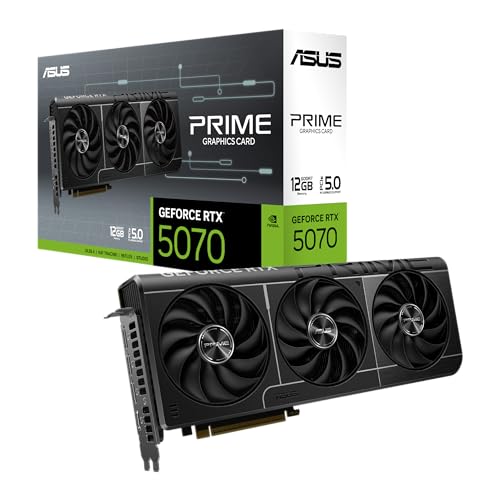

 The RTX 5070 gets the edge here because it is explicitly SFF-ready and built around a compact 2.5-slot design, making it easier to fit into smaller gaming PCs without sacrificing cooling. Its Axial-tech fans and phase-change GPU thermal pad also suggest a more refined thermal-focused design.
✓ Pros
The RTX 5070 gets the edge here because it is explicitly SFF-ready and built around a compact 2.5-slot design, making it easier to fit into smaller gaming PCs without sacrificing cooling. Its Axial-tech fans and phase-change GPU thermal pad also suggest a more refined thermal-focused design.
✓ Pros
- SFF-ready for small-form-factor builds
- 2.5-slot design improves case compatibility
- Axial-tech fans are designed for stronger downward air pressure
- Phase-change thermal pad should help with heat transfer and reliability
- Dual BIOS adds flexibility
- Only 12GB of VRAM
- May be less appealing to buyers prioritizing raw memory capacity
Performance
Winner: RX 9070 XT
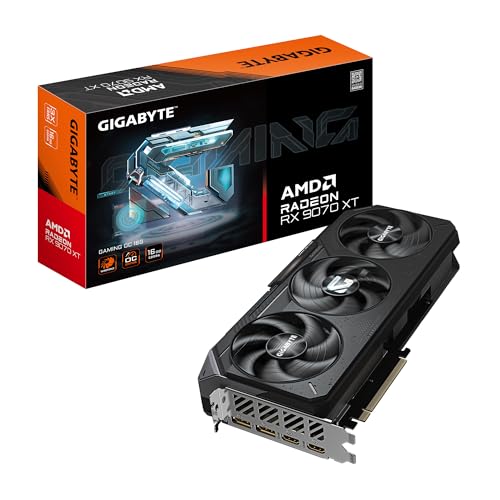

 On paper, the RX 9070 XT has the more gamer-friendly spec advantage because it carries 16GB of VRAM versus the RTX 5070’s 12GB. That extra memory can matter more in modern AAA games, higher texture settings, and longer-term ownership, especially if you want to avoid VRAM pressure in future releases.
✓ Pros
On paper, the RX 9070 XT has the more gamer-friendly spec advantage because it carries 16GB of VRAM versus the RTX 5070’s 12GB. That extra memory can matter more in modern AAA games, higher texture settings, and longer-term ownership, especially if you want to avoid VRAM pressure in future releases.
✓ Pros
- 16GB GDDR6 offers more headroom for modern games
- Better fit for high-texture and future-facing gaming
- WINDFORCE cooling should support sustained performance
- Hawk Fan and thermal gel suggest a strong cooling package
- Good choice for buyers who prioritize native gaming performance
- Uses GDDR6 rather than GDDR7
- Not as clearly optimized for small cases as the RTX 5070
- RGB lighting may be irrelevant for performance-first buyers
Value
Winner: RX 9070 XT
The pricing is close, but the RX 9070 XT edges ahead because it costs just $8 more while offering 4GB more VRAM. For most shoppers comparing frames, longevity, and price, that extra memory makes the value equation more compelling. ✓ Pros- Only slightly more expensive than the RTX 5070
- 16GB VRAM improves long-term value
- 12% discount is stronger than the RTX 5070’s 5% discount
- Prime shipping helps the purchase feel easier and faster
- Slightly higher upfront cost than the RTX 5070
- Value depends on whether you care about NVIDIA-specific features
Cooling and Build Compatibility
Winner: RTX 5070
The RTX 5070 wins this category because its SFF-ready positioning and 2.5-slot footprint make it the safer pick for compact gaming rigs. If you are building in a tighter case, that compatibility advantage can be more important than raw specs. ✓ Pros- SFF-ready design is ideal for compact builds
- 2.5-slot profile helps with installation flexibility
- Axial-tech fans are tuned for better airflow
- Phase-change thermal pad supports thermal consistency
- Less VRAM than the RX 9070 XT
- Compact design may not matter if you have a large case
Features and Ecosystem
Winner: RTX 5070
The RTX 5070 stands out for NVIDIA Blackwell and DLSS 4, which can be a major deciding factor if you care about upscaling support and the broader NVIDIA ecosystem. Even when raw specs are close, features like these often influence buying decisions more than people expect. ✓ Pros- NVIDIA Blackwell architecture
- DLSS 4 support
- HDMI and DisplayPort 2.1 connectivity
- Dual BIOS for added flexibility
- 3-year warranty
- 12GB VRAM may feel limiting sooner than 16GB
- Feature advantage may not matter if you only want native raster performance
RTX 5070 Is the Better Choice If…
- You are building a small-form-factor PC and need a card that is explicitly SFF-ready.
- You want NVIDIA features like Blackwell and DLSS 4.
- You care more about case compatibility and thermals than maximum VRAM.
- You prefer a 2.5-slot card with a more compact footprint.
- You want HDMI/DP 2.1 support and a 3-year warranty.
RX 9070 XT Is the Better Choice If…
- You want the better value for gaming-focused use.
- You want 16GB of VRAM for higher texture settings and longer-term relevance.
- You care most about native performance headroom over ecosystem extras.
- You like the stronger discount and only slightly higher price.
- You want a straightforward, performance-first Radeon option.
Our Final Verdict
The better overall pick in RTX 5070 vs RX 9070 XT is the GIGABYTE Radeon RX 9070 XT Gaming OC 16G. It offers the stronger long-term gaming value thanks to 16GB of VRAM, a slightly better price-to-memory ratio, and a more future-proof spec profile for modern AAA titles. That said, the ASUS SFF-Ready Prime NVIDIA GeForce RTX 5070 Graphics Card is the smarter buy if your build is compact or you specifically want NVIDIA’s DLSS 4 and Blackwell platform advantages. In other words, choose the RTX 5070 for build compatibility and features, but choose the RX 9070 XT if you want the better all-around gaming card for the money.Frequently Asked Questions
Is the RTX 5070 better than the RX 9070 XT?
The RTX 5070 is better if you want NVIDIA features, DLSS 4, or a compact SFF-ready card. The RX 9070 XT is better for most gamers because it offers 16GB of VRAM and stronger value.
Which is better for 1440p gaming: RTX 5070 or RX 9070 XT?
For 1440p gaming, the RX 9070 XT is usually the more attractive choice because its 16GB memory buffer gives it more room for high textures and future games.
Does the RTX 5070 have enough VRAM in 2026?
12GB can still be enough for many games, but it is less comfortable than 16GB if you want higher texture settings or a card that stays relevant longer.
Is the RX 9070 XT worth the extra money?
Yes, especially because the price difference is small and you get 4GB more VRAM. That makes it a stronger value pick for most buyers.
Which GPU is better for small PC builds?
The RTX 5070 is the better choice for small PC builds because it is SFF-ready and uses a 2.5-slot design that improves compatibility.
Get the Full PC Components & Building Buyer's Guide
Download our detailed comparison with specs, scores, and our honest verdict — delivered straight to your inbox.
Free. No spam. Unsubscribe anytime.
Was this review helpful?
Be the first to share your feedback on this review.
Sign in to vote and let us know what you think.
Discussion (0)
No comments yet. Be the first to start the discussion.
Related Reviews
How to Choose the Best Graphics Card in 2026: Complete Buying Guide
Choosing the wrong graphics card can leave you stuck with poor frame rates, a bottlenecked system, or a GPU that simply does not match your monitor. If you are trying to figure out how to choose a graphics card , the good news is that the decision becomes much easier once you focus on resolution, VR
8 Best GPU for 4K Gaming 2026 — Top Picks for Smooth Ultra HD Performance
If you’re searching for the best GPU for 4K gaming 2026 , the challenge is simple: you want high frame rates, ray tracing, and enough VRAM to keep modern AAA games smooth at ultra settings. But with so many cards and prebuilt options, it’s easy to overspend on a flagship you don’t need or undershoot
Ryzen 9800X3D 6 Month Test Review (2026): Honest Verdict After Testing
After a 6 month test, the Ryzen 9800X3D stands out less for flashy design and more for what it enables inside a well-built AM5 system. This is a standard desktop processor in physical form, but the value is in the platform compatibility and the way AMD’s 3D V-Cache implementation keeps the chip focu